
Bowling Practice Session: Set a Goal, Track Shots, and Rest
Table of Contents
Quick answer
A productive bowling practice does not require endless games. Pick one skill, warm up gradually, then work in short blocks with a repeatable starting position and target. Record only a few observations, rest before fatigue changes your motion, and finish by identifying one result to keep and one question for the next session. Stop if pain or unsafe lane conditions appear.
Choose one practice goal
A narrow goal makes feedback easier to interpret. Instead of trying to improve everything, select one measurable task that suits your experience and current equipment. Examples include consistently beginning from the same board, looking at one target through release, converting a specific spare, or completing a balanced finish.
A score is an outcome, not always a useful practice goal. Pin carry, lane transition, and random variation can hide whether the chosen motion improved. Define success as a repeatable action or a simple pattern you can observe.
Plan before arrival
Call or check the center's current practice availability, lane rate, time limit, and equipment rules. League play, events, or lane maintenance may reduce open lanes. If you want coaching, confirm whether instruction must be booked and whether outside coaches are permitted.
- Bring clean, approved bowling shoes or plan to rent them.
- Check personal balls for visible damage and identify each one.
- Pack a clean towel and only center-approved cleaning products.
- Bring water and any medically necessary supplies.
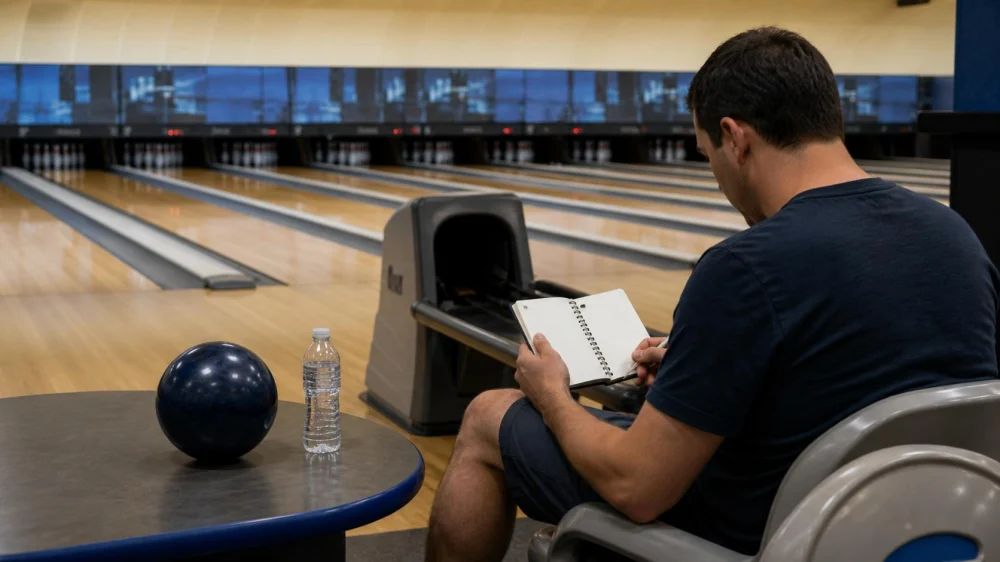
- Write the single practice goal in a notebook or phone note.
Do not apply substances to shoes, balls, or the approach unless rules and staff explicitly allow them. A surface change can affect other bowlers and may violate center or competition requirements.
Start with a gradual warm-up
Begin with comfortable general movement and easy deliveries rather than maximum effort. Use the first shots to observe footing, ball fit, and lane response. Avoid forcing extra speed or rotation before your body and timing feel ready.
If a thumb or finger sticks, the ball feels unexpectedly heavy, or the approach is wet, tacky, or slippery, stop. Set the ball down safely and ask staff or a qualified pro shop professional for help. Do not keep throwing through sharp or increasing pain.
Use short practice blocks
Divide the session into small groups of attempts. One block might use the same starting board and visual target; another might repeat a common spare. Pause between blocks to note the result instead of changing something after every delivery.
For accuracy work, count how often the ball passed near the intended target. For spare work, record the leave and conversion rather than total score. For balance, note whether you could hold the finish under control. The measure should match the goal.
Track useful observations
Detailed ball-tracking data can help experienced players, but recreational practice can use a simple three-part note: starting position, intended target, and observed result. Add a brief cue such as balanced, rushed, missed left, or missed right.
Record lane number, approximate time, and equipment only when they help you compare future sessions. Do not treat a single frame as proof. Look for a repeated pattern across several comfortable attempts.
Rest and protect the approach
Solo practice can move quickly because there is little waiting between turns. Deliberately pause, drink water, and allow breathing and grip tension to settle. Fatigue can change footwork and release before the bowler notices it.
Keep balls on the rack, bags out of walkways, drinks behind the bowling area, and hands away from the ball return opening. Yield to bowlers on nearby approaches according to local courtesy. Tell staff immediately about spills, debris, equipment noise, or anything unusual on the lane.
Make controlled adjustments
Change one variable at a time. If the ball repeatedly misses the intended path, decide whether to adjust the starting position, visual target, speed, or equipment—but not all together. Give the change a small block of comfortable attempts before evaluating it.
Lane oil changes as play continues, so a different ball reaction does not automatically mean the delivery failed. If you cannot separate lane reaction from technique, record the question and ask a qualified coach or pro shop professional rather than making a risky mechanical change.
Session checklist
- Confirm lane availability and center rules.
- Select one specific practice goal.
- Inspect shoes, ball, and approach conditions.
- Warm up gradually with comfortable effort.
- Practice in short, repeatable blocks.
- Track one or two observations that match the goal.
- Schedule water and rest pauses.
- Stop for pain, poor ball fit, or unsafe conditions.
- End with one takeaway and one next-session question.
FAQ
Should I keep score during practice?
You can, but it may distract from a skill goal. Track the action being practiced first and use score only when it adds useful context.
How many games should I practice?
There is no universal number. Lane time, experience, pace, health, and fatigue differ. Stop while you can still repeat the motion comfortably and safely.
Should I practice only strikes?
No. Spare attempts, starting-position consistency, balance, and routines can be more repeatable practice targets than strike count.
What if the lane changes during the session?
Note the new ball reaction, make one controlled adjustment, or ask for guidance. Lane transition is normal and should not prompt a rushed series of changes.
Review and next steps
At the end, write what stayed consistent, what changed with fatigue or lane transition, and the next focused question. Clean and store equipment according to manufacturer and center rules. A short, specific session with clear notes is easier to build on than a long session with no defined purpose.
Evidence note: This is general recreational planning guidance. Center rules, equipment instructions, competition requirements, and individual coaching or medical advice take priority.





 Lucky Strike North Brunswick4.0 (4706 reviews)
 Main Street Sport and Social5.0 (50 reviews)
 Bowlero Bristol4.0 (898 reviews)
 Our Town Alley4.0 (529 reviews)
 Hamilton Lanes and Entertainment Center4.0 (316 reviews)
 Break Point Bowl & Entertainment4.0 (474 reviews)
 Why Axis Tilt Impacts Ball Length
 Best Bowling Alley Tips for Busy Nights
 Best Bowling Alley Tips for Weekend Bowling: Improve Your Game and Enjoy Your Visit
 Best Bowling Balls for Beginners: Affordable High Performance
 How to Join a Bowling League in the US: Beginner Guide and Tips | Southwestern Lanes
 Best Bowling Tips for Casual and Competitive Players