
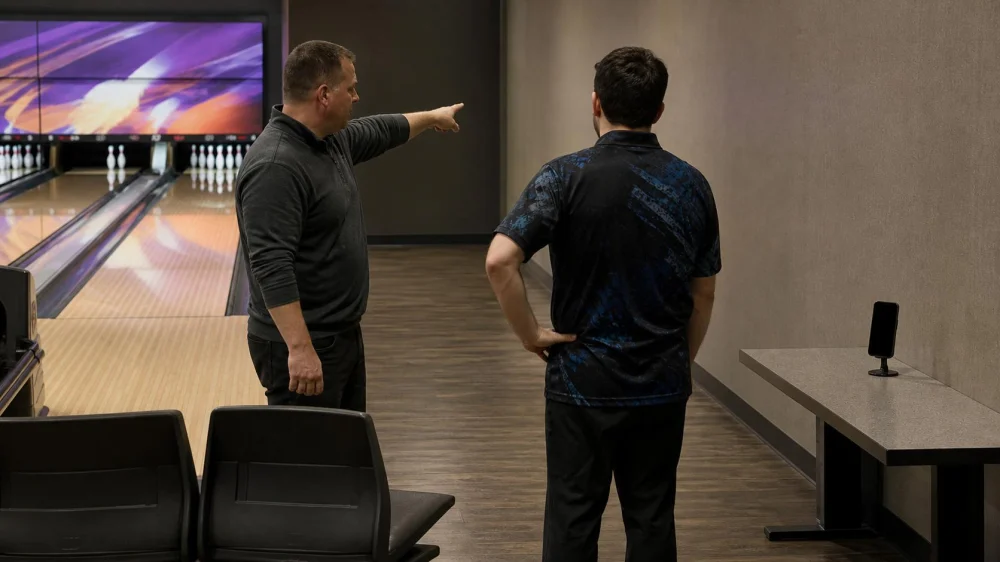
Record a Bowling Practice: Permission, Placement, and Privacy
On this page
Quick answer
Ask the bowling center before recording and obtain consent from anyone intentionally featured. Use a small stable device in a staff-approved location outside the approach, ball return, seating access, and emergency routes; never place equipment on the lane or cross the foul line. Frame only the bowler and needed reference points, stop if traffic changes, review clips off the approach, and store or share files according to the agreed privacy plan.
Spare Time Entertainment
NorthamptonHampshire CountyMassachusetts
525 Pleasant St, Northampton, MA 01060, USA
Why a useful camera angle must also fit a working bowling center
A rear, side, or diagonal view can help compare timing, balance, swing path, footwork, and ball motion, but the best technical angle may occupy space used by bowlers, staff, wheelchairs, carts, or ball returns. Other guests and score displays may enter the frame. Permission, stable placement, and minimal capture matter as much as image quality.
This guide is for United States recreational bowlers recording their own ordinary practice for personal review. It is not coaching certification, event media permission, surveillance guidance, or legal advice. Venue policy, league or tournament rules, privacy law, minors, music, commercial use, and accessibility needs vary.

Break Point Bowl & Entertainment
West HaverstrawRockland CountyNew York
40 US-9W, West Haverstraw, NY 10993, USA
Practical checklist
- Venue filming policy, manager approval, lane assignment, league or event rules, commercial-use limits, flash and lighting restrictions, and staff contact.
- Bowler consent, coaches and teammates, neighboring lanes, minors and guardians, spectators, staff, score screens, conversations, and background audio.
- Phone or camera, case, battery, storage, airplane or silent mode, lens, field of view, frame rate, remote, small tripod, clamp rules, and backup.
- Rear, side, or diagonal angle, approach and foul line, release area, ball path, pins, score screen exclusion, lighting, reflections, and useful reference points.
- Tripod footprint, weight, leg locks, cables, power bank, drinks, ball return, seating, aisle, accessible route, exit, staff path, and changing traffic.
- Practice goal, number of shots, warm-up, fatigue, ball and lane changes, note-taking, clip names, review breaks, and stop time.
- File access, faces and voices, metadata, cloud sync, shared album, editing, retention, deletion request, public posting, and coaching handoff.
Step-by-step plan
- Ask staff where and when recording is allowed, describe the device and support, and accept a different angle or no recording when operations require it.
- Tell nearby participants what will be captured, obtain needed consent, and narrow the frame to avoid other guests, minors, score data, and conversations.
- Choose one practice question and set a staff-approved angle that captures the needed movement without placing equipment on the approach, lane, or traffic route.
- Lock tripod legs or secure the approved support, remove dangling cables, disable flash and disruptive sounds, and test the frame before anyone bowls.
- Record a short set, with one person monitoring the device if needed, and stop immediately if people, carts, bags, food, or lane service change the clearance.
- Move fully away from the approach before reviewing, label useful clips with non-sensitive practice notes, and avoid changing technique from one ambiguous frame alone.
- Delete accidental captures when appropriate, share only with agreed recipients, remove unnecessary metadata, and return the area clear before leaving.
Keep the venue permission and restrictions, lane and time, participants and consent, practice goal, approved camera position, device settings, ball and lane notes, clip identifiers, observations, sharing list, retention date, deletion requests, and any incident. Do not publish reservation, score-account, or bystander details.
Limits and important notes
Do not put a camera, tripod, bag, cable, or light on the lane, approach, ball return, aisle, ramp, or exit; cross the foul line; use flash; distract bowlers; record private conversations; or film minors without required permission. Video angle can distort mechanics and cannot establish pain, injury, or equipment diagnosis.
Stop recording when staff asks, another guest objects, consent changes, equipment shifts, traffic enters the area, a ball or cart could strike the device, or the bowler has pain or dizziness. Ask staff to resolve placement or privacy conflict, and seek appropriate coaching or medical help instead of using video as the sole answer.
Frequently asked questions
Where is the best camera angle?
It depends on the practice question and the venue's safe approved space. A technically ideal angle is not acceptable if it obstructs operations.
Can a tripod stand behind the approach?
Only with venue approval and enough protected clearance for bowlers, staff, seating, accessibility, bags, and unexpected traffic.
May I record neighboring lanes in the background?
Minimize them and ask about consent and policy. Reframe, wait, crop, or stop rather than treating bystanders as unavoidable content.
Should I review after every shot?
Usually review in planned short breaks away from the approach so recording does not delay play or encourage constant mid-frame changes.
Can video diagnose a bowling injury?
No. Stop painful activity and seek a qualified medical professional; video may provide context but is not a diagnosis.
Sources and evidence
Use the bowling center's current filming and safety policy, league or tournament rules, device and tripod instructions, consent requirements, and the coach's practice plan. Applicable privacy, minors, music, and commercial-use rules override a generic recording checklist.
Conclusion and next steps
Ask permission, obtain consent, choose one practice question, and place a small stable device only in a staff-approved clear location. Record short sets without flash or bystander capture, review away from the approach, stop for changing traffic or objections, and keep, share, or delete files according to the agreed privacy plan.


 Jersey Lanes4.0 (1053 reviews)
 Bowlero Limerick4.0 (1681 reviews)
 Pinsetter Bar & Bowl4.0 (1710 reviews)
 NJ Grunt's Sports Bar3.0 (6 reviews)
 Tony Rado’s Pro Shop4.0 (30 reviews)
 Precision Fit Bowling Pro Shop4.0 (7 reviews)
 Why Ball Span Is Important for Comfort: Understanding the Key Factors
 Best Cheap Bowling Nights Near Me for Fun and Savings
 How to Develop a Consistent Strike Shot in Bowling: Tips and Techniques
 House Bowling Ball Fit: Check Weight, Holes, and Control
 Bowling Tips for Weekend Players Who Love the Game
 Top Rated Bowling Centers in Los Angeles with Affordable Deals and Entertainment | Southwestern Lanes