
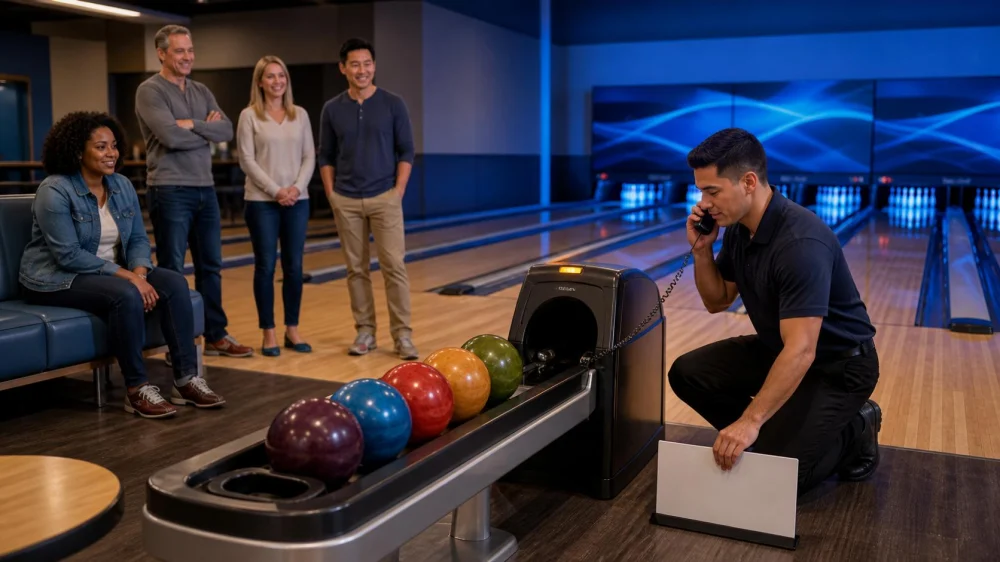
Bowling Ball Return Stops: Keep Hands Out and Call Alley Staff
On this page
Quick answer
If a bowling ball does not return, stop throwing on that lane, keep everyone behind the foul line, and notify alley staff. Do not reach into the return opening, remove a cover, enter the lane, walk down the gutter, or try to retrieve the ball from machinery.
Tell staff the lane number, when the ball disappeared, the ball’s color and identifying marks, and whether the return is making noise, vibrating, or holding other balls. Follow their instructions about waiting, changing lanes, or using another verified ball.
Buckland Billiards and Bar
ManchesterCapitol Planning RegionConnecticut
1131 Tolland Turnpike, Manchester, CT 06042, USA
Stop play and protect the area
Move waiting bowlers away from the return opening and keep children supervised. Do not pile more balls onto a stopped rack. Set drinks, towels, bags, and phones away from the approach so no one trips while attention is divided.
If there is smoke, a burning odor, sparking, a loose cover, an exposed moving part, or a person’s clothing or body is caught, alert staff immediately and use emergency help. Do not touch controls, cords, or machinery unless you are trained and authorized by the facility.
Report the exact problem
- State the lane or pair number.
- Give the frame and approximate time of the missing ball.
- Describe the ball’s color, weight marking, logo, serial, name engraving, or unique plug pattern without confusing it with a house ball.
- Say whether pins reset and scoring continued.
- Report unusual sound, smell, heat, or repeated delay.
- Count the balls already visible on the rack.
- Provide a phone photo of the ball from before play when helpful.
A clear description helps staff distinguish a machine stop, a ball held in the back, a ball routed to the wrong lane, or a scoring-cycle issue.
Wait without entering machinery or lane
Remain in the seating area unless staff direct otherwise. Bowling lanes have oil and are not walking surfaces; crossing the foul line can cause a fall and contaminate shoes. The return system contains moving and pinch-point components hidden from view.
Do not send additional balls as a test. Do not use another player’s ball without permission. If staff moves the group to a different lane, ask whether scores transfer and whether the missing ball will be delivered to the new rack or held at the desk.
Count equipment and resume safely
When staff clears the problem, match every personal ball to its owner before play restarts. Inspect the recovered ball visually for fresh chips, gouges, cracks, oil, heat, or unusual residue. If damage is suspected, stop using it and show staff before cleaning or leaving.
Confirm the correct bowler, frame, and first delivery on the scoring screen. Reestablish the lane-courtesy order with neighboring lanes. Take one controlled warm-up delivery only if the center permits it after a delay or lane move.
Return-stop checklist
- Play stopped immediately
- Everyone kept behind the foul line
- Hands kept out of return opening
- No covers or controls touched
- Lane, time, and ball description reported
- Visible balls counted
- Staff instructions followed
- Recovered equipment identified and inspected
- Score and bowler order verified before restart
Limitations
Ball-return designs and center procedures vary. This article does not authorize machinery access, diagnose a pinsetter, or teach maintenance. Only trained facility staff should isolate, open, or clear equipment.
FAQ
Can I reach just inside the opening?
No. Hidden moving parts and pinch points can remain dangerous even when the rack appears still.
Should I roll another ball?
No. It can add to the jam or damage more equipment.
Can I walk down the gutter?
No. Stay behind the foul line and let trained staff retrieve the ball.
What if my ball returns damaged?
Stop using it, photograph it, report it before leaving, and follow the center’s incident process.
Will the score be lost?
Ask staff. Scoring may be recoverable or transferable depending on the system.
Evidence notes
Useful incident evidence includes lane, time, frame, ball identification and pre-play photo, unusual sounds or odors, staff notification, lane-move record, scoring status, recovered-ball condition, and a center incident number. Do not photograph inside opened machinery or interfere with service.
Conclusion
A missing bowling ball is a staff problem, not an invitation to reach into equipment. Stop play, secure the area, describe the ball and symptoms, wait behind the foul line, then inspect equipment and restore scoring order before the next throw.





 ThunderBowl Lanes4.0 (254 reviews)
 Doc's Bar & Grill3.0 (18 reviews)
 Jib Lanes4.0 (1340 reviews)
 Agawam Bowl4.0 (235 reviews)
 Colonial Bowling and Entertainment4.0 (1552 reviews)
 Oakwood Lanes4.0 (521 reviews)
 How to Control Hook on Transitioning Lanes
 Affordable Bowling in Boise for Families – Fun Budget-Friendly Guide
 Understanding the Importance of Ball Speed and Release Timing in Bowling
 How to Bowl a Perfect Game: Expert Tips and Key Factors That Matter Most
 How to Avoid Overturning and Losing Control of Your Hook | Southwestern Lanes
 How to Improve Power Without Sacrificing Control: The Ultimate Guide