
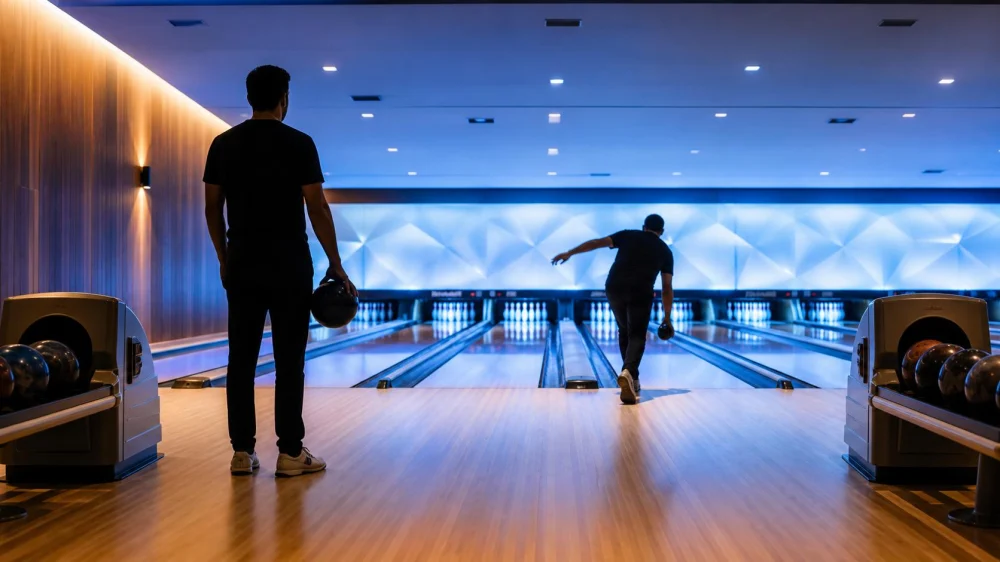
Bowling Lane Courtesy: Pause, Watch, and Take Your Turn
Table of contents
Quick answer
Lane courtesy means noticing bowlers on nearby approaches, yielding according to the center or event rule, and making your delivery without unnecessary delay once it is your turn. In casual open bowling, a common practice is to avoid starting at the same time as a bowler immediately beside you, but house rules vary. In leagues and tournaments, follow the announced USBC or event procedure. When uncertain, pause, make eye contact, and ask staff or the event official.
One Stop Bowler's Shop
SayvilleSuffolk CountyNew York
Inside of Bowlero Sayville Lanes, 5660 Sunrise Hwy, Sayville, NY 11782, USA
What lane courtesy means
Adjacent bowling approaches are close enough that two people moving together can distract or crowd each other. Courtesy creates a predictable rhythm: each bowler checks nearby lanes, one person proceeds, and the other waits behind the approach. It is not permission to control every lane in view or to hold up play indefinitely.
The exact waiting range differs. A center may expect one-lane courtesy during open bowling, a league may publish its own procedure, and a tournament may require a wider or more specific pattern. The phrase “lane courtesy” therefore describes a coordination principle, not one universal distance and sequence.
Courtesy begins before the first step. Keep chairs, bags, drinks, food, and spare balls outside the approach. Return to the seating area after the delivery rather than standing near the foul line to watch every pin-cycle detail. A clear approach gives the next bowler room to prepare.

Lucky Strike Philadelphia
PhiladelphiaPhiladelphia CountyPennsylvania
1336 Chestnut St, Philadelphia, PA 19107, USA
Ask which rule applies
At check-in, ask whether the center uses one-lane courtesy for casual play and whether leagues, tournaments, or special events are operating nearby. Look for posted rules. If your lane shares a boundary with organized competition, staff may give different guidance to reduce interference.
Do not assume a rule seen on television applies to a birthday party or open-bowling session. Professional and championship formats manage pace, lane pairs, television, and officials differently. Likewise, a casual center custom does not replace the written rules of a certified competition.
When two bowlers are both ready and neither knows who should go, a small gesture is enough. Step back, indicate that the other person may proceed, then take your turn after they clear the approach. Avoid arguing over who arrived first. If the same confusion repeats, calmly agree on an order or ask staff.
Use the approach safely
Wait behind the approach until it is your turn. Watch for someone already beginning a pre-shot routine on the adjacent lane. Once that bowler starts moving, do not step into their peripheral space. Keep children and non-bowlers from crossing behind active deliveries.
Wear clean, dry bowling shoes on the approach and keep street shoes away. Food, drinks, and wet hands can change the sliding surface. If the approach feels sticky, slippery, or damp, stop and notify staff. Do not apply powder, cleaner, rosin, or another substance to the floor; a change that helps one person may create a hazard for the next.
Stay behind the foul line. USBC’s basic rules define a foul as a player’s body going beyond the foul line and touching the lane, equipment, or building during a delivery. Even in casual play, the lane surface is not a walking area. If a ball stops, pins remain standing incorrectly, or equipment needs attention, use the call button or contact staff.
Be ready without rushing
Courtesy also means being prepared when your turn arrives. Watch the scoring monitor, select the ball before the prior bowler finishes when it is safe, dry your hand in the seating area, and keep optional conversations brief. A long routine can be part of a bowler’s normal process, but repeated phone use or leaving the lane without telling the group causes avoidable delays.
Preparation should not become pressure. A beginner may need time to check finger fit, remember the order, or position a bowling ramp. Give clear, quiet help, then step away from the delivery path. Never hurry someone into using a ball that feels stuck or too heavy.
After releasing the ball, observe the result from a stable position, then return promptly. Do not practice swings with a ball where people pass behind you. Save coaching discussions for the seating area so the approach remains available.
Coordinate your own group
Set the player order on the scoring console and explain it before starting. Ask one person to help with name corrections, bumpers, or turn reminders. When the group uses two lanes, decide whether players stay on one lane or rotate according to the center’s scoring setup. Do not move a player to another lane without updating staff or the console.
Place personal balls on the correct rack and avoid loading more equipment than the return can hold. Distinct labels help prevent mix-ups. Keep rental balls available to the people using them rather than collecting many options at one seat.
If a guest steps away, agree whether to wait, skip temporarily, or ask staff to adjust the order. Never roll for someone else without consent and center approval. A predictable group order makes it easier to coordinate with neighboring lanes.
Handle interruptions and disputes
If another bowler repeatedly starts beside you, first consider whether they know the local custom. A friendly sentence such as “Are we using one-lane courtesy here?” is clearer than an angry gesture. Explain the shared goal: avoiding simultaneous approaches and keeping play moving.
For a serious distraction, unsafe behavior, or disagreement, step off the approach and contact staff. Do not confront someone while holding a ball. Staff can clarify house rules, move a group when space allows, or involve an event official.
Equipment delays change the rhythm. When pins, ball return, or scoring stops, alert staff and keep everyone away from the lane machinery. Neighboring bowlers should continue only if staff says it is safe. When play resumes, re-establish the order rather than rushing to “catch up.”
Help children and first-time bowlers
Give a short demonstration without overwhelming the new bowler. Show where to wait, how to carry the ball with two hands, how to recognize their turn, where the foul line is, and how to leave the approach. Repeat one cue at a time.
An adult should supervise children near ball returns and approaches. Fingers can be pinched between moving balls, and a dropped ball can injure feet. Keep unused hands away from the return opening. Ask staff for a ramp or lighter ball rather than having a child struggle with unsuitable equipment.
Praise awareness and safe pacing, not only scores. A first-time bowler who waits, checks both sides, and clears the approach is already practicing the most useful group habit.
Know when competition rules differ
USBC maintains playing rules for certified league and tournament competition. Its championship rules may specify one-lane or one-pair courtesy and define prohibited delays in detail. Event management can announce procedures tailored to that competition.
Before league or tournament play, read the event rules and attend the briefing. Ask the league officer or tournament director how courtesy interacts with lane pairs, slow play, breakdowns, warm-up shots, and absent bowlers. Do not settle a formal rules question by polling casual spectators.
This guide describes practical behavior, not a ruling for a score dispute. The official in charge should interpret the current rulebook and event conditions.
Frequently asked questions
Who goes first when two adjacent bowlers step up together?
Follow the posted house or event rule. If none is clear, one bowler should simply yield with a gesture. Agreeing quickly is more courteous than debating priority.
How many lanes away should I watch?
The expected range varies. One adjacent lane may be common in casual play, while competition can require more. Ask the center or event official.
Can I stand on the approach while waiting?
Wait off the approach until you are ready and neighboring courtesy permits. Standing there can signal that you are starting and block others.
What if the next bowler is not ready?
Your group can briefly remind them, adjust the order through the scoring system or staff, or allow another ready player according to house rules. Avoid repeated delays.
Does lane courtesy affect scoring?
Courtesy itself usually manages pace and distraction. Formal penalties or procedures depend on the league or tournament rules, which an official should interpret.
Sources and verification
- United States Bowling Congress, Basic Rules — official introductory explanation of legal delivery, fouls, wrong lanes, and paired-lane competition.
- USBC Playing Rules — official current rulebook access point.
- USBC Rules — explains the organization’s rule interpretation role for league and tournament competition.
Use the bowling center’s current house rules for open bowling and the designated official for league or tournament decisions.
Conclusion
Good lane courtesy is quiet coordination. Learn the local rule, watch nearby approaches, yield clearly, make the delivery when ready, and clear the space. Those small habits protect concentration, reduce confusion, and keep casual groups and experienced bowlers moving at a comfortable pace.





 Norwich Bowling & Entertainment Center4.0 (503 reviews)
 Bowlero Norwalk4.0 (1345 reviews)
 Whitestone Pro Shop4.0 (12 reviews)
 Pro Shop Services Professional Bowling Instruction & Supplies5.0 (2 reviews)
 Round1 Bowling & Arcade Exton Square3.0 (1000 reviews)
 Bilinskas Brothers Bowling Shop4.0 (29 reviews)
 How to Bowl a Spare Even When the Setup Looks Impossible
 Top Bowling Centers in Nashville for Music, Fun, and Bowling Experiences
 Cheap Bowling Near Me for Date Night, Family Fun, and Weekend Activities Guide
 Why Bowling Is Making a Comeback Among Young Adults
 Best Bowling Balls for League Players Seeking Consistent Performance
 Bowling Tournament Check-In: Roster, Gear, and Timing