
How to Ask About Adaptive Bowling Equipment Before You Visit
On this page
- Quick answer
- Describe the bowling setup you need
- Confirm adaptive equipment and availability
- Verify the route from arrival to lane
- Plan lane assignment and staff support
- Discuss communication and sensory needs
- Confirm the reservation in writing
- Adaptive-bowling checklist
- Limitations and safety notes
- Frequently asked questions
- Request one equipment photo
Quick answer
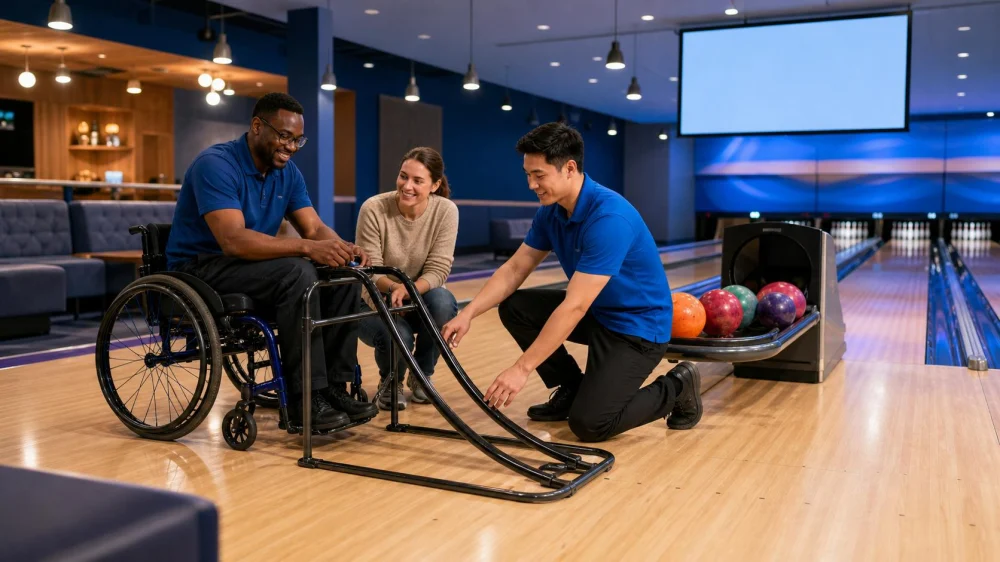
Call the bowling center before booking and describe the functional setup required: bowling ramp, lightweight balls, handle ball, ball pusher, lane bumper, wheelchair space, transfer-free approach, accessible scoring controls, shoe exception, support person, service animal, quieter time, or staff orientation. Ask how many items exist, which lanes accept them, whether they can be reserved, and who sets them up.
“Accessible building” does not automatically mean the preferred equipment, lane layout, and service process will be ready without notice.
Describe the bowling setup you need
Focus on what allows the bowler to participate rather than sharing an entire diagnosis. For example: “The bowler remains in a wheelchair and releases from a ramp,” “We need a ball under a stated weight,” or “The player uses a support person to position equipment.”
Ask the center to explain its safety rules and available modifications. The bowler should direct assistance and remain the focus of communication unless they ask a companion to speak.
Confirm adaptive equipment and availability
Ask for the equipment name, quantity, dimensions, compatible lanes, ball weights, condition, cleaning process, and reservation rules. A center may have one ramp shared among many lanes or bumpers that operate only on certain scoring systems.
Confirm whether personal adaptive equipment is allowed and what inspection or floor-protection rules apply. Do not bring improvised ramps, pushers, or release devices without approval; they can damage the approach or create pinch and trip hazards.
Verify the route from arrival to lane
Check accessible parking or drop-off, entrance, doors, counter height, seating, restroom, food area, and the path to the assigned lane. Ask about stairs, ramps, carpet transitions, narrow gates, crowded arcades, and elevation changes between concourse and approach.
Confirm where mobility devices and companions can remain without blocking players, ball returns, exits, or server routes. A lane at the end of a bank may provide more maneuvering space, but the center should evaluate the actual layout.
Plan lane assignment and staff support
Ask the reservation agent to assign a compatible lane and note the equipment. Confirm whether staff install and remove the ramp, activate bumpers by player, adjust scoring names, or offer a brief orientation.
Define what staff can and cannot do. Lifting, transferring, positioning a person, or providing personal care may be outside their role. Bring a trained support person or personal equipment when needed and permitted.
Discuss communication and sensory needs
Ask about music, announcements, flashing lights, cosmic bowling, crowds, ball impact noise, food smells, and quieter sessions. Confirm whether ordinary lighting can remain on, whether a lane farther from speakers is available, and whether breaks affect paid time.
For communication, consider written scoring instructions, speech-to-text, clear face visibility, extra response time, or an interpreter. Ask how emergency announcements are communicated.
Confirm the reservation in writing
Record date, time, lane count, equipment, lane location, lighting, staff contact, price, support-person charges, shoe policy, food minimum, arrival time, and cancellation terms. Reconfirm the day before for scarce equipment.
On arrival, inspect the setup before starting paid time. Stop if equipment is unstable, damaged, poorly positioned, or blocking another lane.
Adaptive-bowling checklist
- Describe functional participation needs.
- Reserve exact equipment and a compatible lane.
- Verify arrival route, restroom, and seating.
- Plan wheelchair and companion space.
- Clarify staff setup and assistance limits.
- Choose lighting and noise conditions.
- Confirm price, timing, and shoe policy.
- Inspect the setup before play.
Limitations and safety notes
- This guide is not medical, legal, engineering, or equipment-fitting advice.
- Never enter the oiled lane surface or cross the foul line to retrieve equipment.
- Keep ramps, chairs, bags, and mobility devices clear of ball returns and exits.
- Stop play for pain, instability, equipment damage, or unsafe crowding.
Frequently asked questions
Can a wheelchair user bowl without transferring?
Some centers and equipment support transfer-free play; confirm lane layout and approved release method.
Are bumpers only for children?
Policies vary. Ask whether bumpers can be activated for an individual bowler as an adaptive feature.
Can I reserve a bowling ramp?
Often, but quantities may be limited. Reserve and reconfirm rather than relying on walk-in availability.
Must every player rent shoes?
Ask about adaptive, medical, and lane-protection policies before arrival.
Can a service animal stay near the lane?
Discuss a safe position away from moving balls, returns, food, and the approach while keeping the animal with its handler.
Request one equipment photo
Ask the center to confirm the ramp or device model and send a current photo of the assigned lane area when possible. Use it to plan positioning, companions, and arrival before paying a deposit.


 Bowlero Milford4.0 (1430 reviews)
 Pavlinko Pro Shop5.0 (53 reviews)
 Norwich Bowling & Entertainment Center4.0 (503 reviews)
 Tilted 104.0 (396 reviews)
 Lucky Strike Bar & Grill @ Port Jeff Bowl5.0 (3 reviews)
 Larkfield Lanes4.0 (189 reviews)
 How to Master Bowling Footwork Quickly
 Top Rated Bowling Alleys Near Me for Date Nights and Social Fun
 Bowling Tips That Help You Improve Balance, Timing, and Accuracy
 Best Bowling Alley Tips for Skill Progress | Improve Your Bowling Game
 Why Ball Transfer Matters on Approach in Bowling
 Simple Bowling Strategies to Improve Accuracy and Score