

- step-by-step bowling balance - understanding core stability and posture fundamentals
- bowling footwork mechanics - building a smooth, repeatable approach
- alignment and release control - connecting balance to accuracy
- drills for improvement - practical training routines you can do immediately
- real-world bowling mistakes - what actually goes wrong and how to fix it
- advanced consistency training - turning good form into repeatable performance
How to Improve Bowling Balance and Footwork Step by Step for Better Accuracy
Why Balance and Footwork Decide Almost Everything in Bowling
In bowling, power gets attention, but control wins games. Most players assume accuracy comes from the arm swing, yet the real foundation is how the body moves toward the foul line. When balance collapses, even a perfect swing becomes inconsistent. When footwork is uneven, the release point shifts every time.
Many amateur bowlers experience the same frustrating pattern: one strike followed by a split, then a gutter ball. This usually isn’t a “bad day.” It’s a movement problem. Understanding how to improve bowling balance and footwork step by step is what separates casual players from consistent scorers.
A coach at Southwestern Lanes often tells beginners that bowling is less about throwing and more about walking correctly. That mindset shift alone can transform a player’s accuracy within weeks.

Building a Stable Foundation Before You Even Move
Body Posture and Center of Gravity Control
Before stepping toward the lane, balance begins in the stance. Your shoulders, hips, and knees should align naturally over your center of gravity. A common mistake is leaning too far forward or locking the knees, which causes instability during movement.
A practical example comes from a league player who struggled with inconsistent releases for years. Once he adjusted his stance to keep his weight slightly forward but centered, his average score increased by nearly 20 pins in one season.
Think of your body like a tripod. If one leg shifts too far, everything tilts. This is why proper posture is the first step in any bowling balance tips strategy.

Relaxation as a Hidden Performance Factor
Tension is one of the most overlooked issues in bowling. Tight shoulders or a stiff wrist will disrupt your timing before you even start your approach. The best bowlers look smooth because they stay relaxed under pressure.
A simple breathing routine before each throw helps reset muscle tension. This is especially useful during competitive games when nerves tend to tighten movement patterns.
Step-by-Step Footwork Development for Consistency
Understanding the Rhythm of the Approach
Footwork in bowling is not just stepping forward; it is timing, rhythm, and coordination. A standard four- or five-step approach works best for most players, but consistency matters more than structure.
Each step should match a specific phase of the arm swing. When your feet rush ahead of your swing, balance breaks. When your swing leads too far, timing collapses. The goal is synchronization.
Common Footwork Mistakes That Destroy Accuracy
One of the biggest issues is inconsistent step length. Players often take a long first step and shorten the last one, which shifts their release point unpredictably. Another issue is crossing the body line, which forces the torso to twist unnaturally.
A real league story illustrates this clearly: a beginner bowler kept missing left pins repeatedly. After video analysis, it was discovered that his final step landed diagonally instead of straight. Once corrected, his spare conversion rate improved dramatically.
Drill-Based Training to Improve Bowling Footwork
One effective drill is the “shadow approach,” where a bowler practices steps without the ball. This helps isolate movement patterns and fix timing errors. Another drill involves walking the approach line slowly while maintaining a steady swing rhythm.
These drills may feel simple, but they build neurological consistency. Over time, your body learns repetition without conscious effort.
Connecting Balance With Release Mechanics
How the Final Step Controls Accuracy
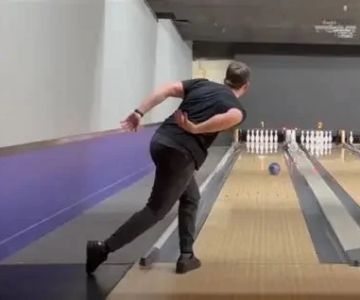
The final slide step is where balance either succeeds or fails. If the body leans too far sideways or backward, the release point shifts off target. A stable slide requires controlled knee bend and forward alignment toward the target line.
This is where many bowlers unknowingly sabotage themselves. They focus so much on throwing power that they forget stability at the moment of release.
Arm Swing Coordination Without Overthinking
A smooth arm swing should feel like a pendulum, not a forced motion. When footwork is correct, the swing naturally follows timing. Trying to manually control the arm often leads to inconsistency.
Instead, think of the feet guiding the rhythm while the arm follows passively. This mental shift is one of the most effective bowling form improvement strategies used by advanced coaches.
Real Case Study: Turning a 140 Average Into a 190 Bowler
At a local league night in Texas, a bowler struggling with a 140 average decided to focus solely on balance and footwork for six weeks. No changes were made to equipment or release style.
Week one revealed unstable posture. Week two revealed rushed footwork. By week four, his timing stabilized, and by week six, his average jumped to 190.
The biggest takeaway wasn’t technique complexity—it was simplification. Removing unnecessary movement created natural consistency.
Advanced Consistency Training for Long-Term Improvement
Repetition Under Controlled Pressure
Once fundamentals are stable, the next step is practicing under mild stress. This can be done by setting small scoring goals or simulating tournament conditions during practice sessions.
This type of training helps replicate real-game pressure, ensuring that balance and footwork remain stable even when nerves are active.
Video Feedback and Self-Correction
Recording your approach is one of the most powerful tools available. Small errors that feel invisible during play become obvious when reviewed. Many bowlers discover uneven timing or leaning issues they never realized existed.
Combining video analysis with structured drills creates rapid improvement cycles.
Integrating Professional Coaching Insights
While self-training is effective, professional feedback accelerates progress. Coaches often identify subtle misalignments that players overlook for years.
Facilities like Southwestern Lanes offer structured coaching environments where these corrections can be made efficiently, especially for players aiming to move into competitive leagues.
Final Performance Mindset Shift
The most important realization in bowling improvement is that balance and footwork are not separate skills—they are one system. When they work together, accuracy becomes natural rather than forced.
Players who master this system often describe bowling as “effortless,” not because it becomes easy, but because unnecessary struggle disappears.
Improving bowling consistency is less about changing everything and more about refining movement quality until it becomes automatic.





 Bowlero East Meadow4.0 (797 reviews)
 Tilted 104.0 (396 reviews)
 West Point FMWR Bowling Center4.0 (105 reviews)
 Bowlero Belleville4.0 (1958 reviews)
 Homefield Bowl4.0 (783 reviews)
 Larkfield Lanes4.0 (189 reviews)
 Tips for Bowling on Dry Lanes: How to Improve Your Game
 How to Find the Best Bowling Deals Near Me in the US
 Bowling Tips for Casual and Competitive Players: Improve Your Game Fast
 How to Practice Bowling at Home Without a Lane: Simple Training Tips
 How to Bowl a Spare Even When the Setup Looks Impossible
 How to Record Your Bowling Games for Self-Analysis