
Rental Bowling Ball Fit: Weight, Holes, and a Safe Test
Article guide
Quick answer
Choose a rental or “house” bowling ball that feels manageable and releases without catching your fingers. Inspect the surface and holes, then make a few easy test shots rather than selecting by the printed weight alone. If you must squeeze hard, lose balance, feel a sharp edge, or experience pain, stop and try a different ball or ask bowling-center staff for help.

Dave & Buster's Pelham Manor
Pelham ManorWestchester CountyNew York
881 Pelham Pkwy, Pelham, NY 10803, USA
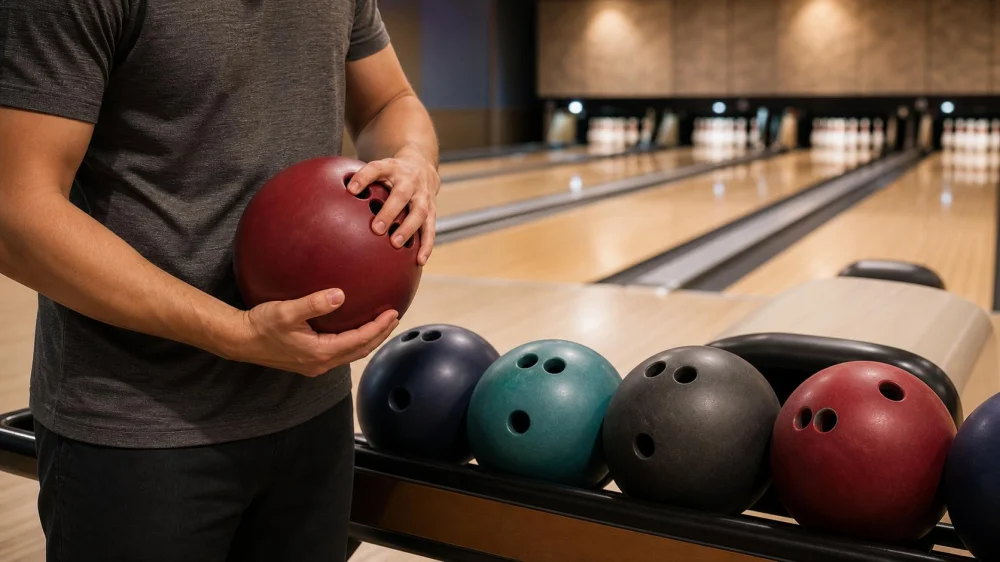
Inspect a house ball first
House balls are designed for many users, so finding a perfect hand match on the rack is unlikely. Start by looking for several nearby weights and grip sizes. Their colors are not a universal weight system; read the actual weight marking on each ball and compare the holes.
Rotate the ball while it remains supported on the rack. Look for a crack, deep gouge, chipped hole, sharp edge, or loose material. Minor cosmetic marks are common, but damage around a gripping hole can irritate the hand or affect release. Set a questionable ball aside without placing it where it can roll, and notify staff.
Keep hands dry enough for a consistent grip. Food, beverages, lotion, and moisture belong away from the ball and approach. If the ball feels oily or contaminated, ask staff about their approved cleaning process rather than applying an unapproved product.

Doc's Bar & Grill
Lawrence TownshipMercer CountyNew Jersey
2420 Brunswick Ave Bus, Lawrence Township, NJ 08648, USA
Check the finger and thumb holes
Insert the fingers slowly while the ball is safely cradled with the other hand or supported at the return. Do not force a swollen finger, ring, or tight joint into a hole. Remove rings or other hand jewelry if doing so is safe and practical.
The holes should allow a comfortable grip and release. Holes that are too large can encourage squeezing and make the ball feel insecure. Holes that are too small can pinch or cause a finger or thumb to stick. A house-ball span is standardized for a broad audience, so the distance between holes may still feel awkward even when each hole seems large enough.
Try the grip several times without swinging the ball. The hand should enter and exit smoothly. If the thumb hangs up, the fingertips cannot sit comfortably, or the edges rub, return that ball to a stable rack and try another combination.
Choose a manageable weight
A printed weight is useful, but comfort, strength, balance, hand fit, experience, and current physical condition all matter. A ball that is too heavy may encourage gripping, muscling the swing, or losing posture. A very light ball can also be hard to control if the grip is poor or the player forces it.
Begin conservatively. With staff approval and clear space, cradle the ball close to the body using both hands. Do not perform curls, overhead lifts, or exaggerated practice swings. If simply carrying the ball strains the wrist, elbow, shoulder, or back, select a lighter option.
You may see a “percentage of body weight” rule online. The United States Bowling Congress uses roughly 10 percent only as a starting guideline in a youth coaching resource and says to adjust for size, strength, and ability. It is not an individual medical prescription or a reason to ignore discomfort.
Test it on the lane
Wait for your assigned lane and for the ball return to stop moving before collecting a ball. Keep hands away from the return opening and moving machinery. Carry the ball securely with both hands until it is your turn, then use a simple, controlled approach.
Make the first few deliveries easy. Watch for these signals:
- you can maintain balance without lunging or twisting;
- the ball leaves the hand without a delayed thumb release;
- you do not need to squeeze throughout the swing;
- the fingers, wrist, elbow, shoulder, and back remain comfortable;
- you can repeat the motion without fatigue building immediately.
Score is not the test. A gutter ball does not prove the equipment is wrong, and a strike does not prove the fit is safe. Judge comfort and controllability over several relaxed shots. Change only one variable at a time—either hole fit or weight—so the comparison is useful.
Selection checklist
- Find several house balls in a conservative weight range.
- Read the actual weight marking rather than relying on color.
- Inspect the cover and gripping holes for damage.
- Remove hand jewelry when appropriate.
- Test entry and release while the ball is supported.
- Reject a grip that pinches, sticks, or requires hard squeezing.
- Carry the ball close to the body with both hands.
- Make a few controlled test shots on the assigned lane.
- Stop if pain, numbness, weakness, or loss of balance occurs.
- Ask staff to help locate another ball or an adaptive option.
Limitations and safety
This guide is general recreational information, not medical or coaching advice. People with an injury, recent surgery, joint instability, reduced grip, pregnancy-related limitations, or another health concern should follow guidance from a qualified clinician. Stop bowling for pain, numbness, sudden weakness, dizziness, or other concerning symptoms.
Do not retrieve a stuck ball, reach into machinery, enter a lane, or attempt repairs. Lane surfaces may be slick beyond the foul line. Ask center staff for help with equipment, spills, or an unsafe approach. Children and bowlers who need physical assistance should be supervised according to center rules.
Frequently asked questions
Should I use the heaviest ball I can lift?
No. Lifting a ball once is different from controlling repeated deliveries. Choose a weight and grip that let you stay balanced and release smoothly without strain.
Why does my thumb stick in a house ball?
The hole size, span, hand swelling, insertion angle, or squeezing may contribute. Stop using that ball and try another fit; do not force the hand free during a swing.
Can I put tape into a rental ball's holes?
Ask center staff first. Altering shared equipment may be prohibited, and incorrect placement can create a new fit problem. Staff may have another house ball or an approved option.
When should I consider a custom-drilled ball?
If you bowl regularly and cannot find a comfortable, repeatable house-ball grip, a qualified pro shop can measure your hand and discuss equipment suited to your goals. Custom fit still needs periodic review as the hand changes.
What if the only comfortable holes are on a heavier ball?
Do not trade manageable weight for a risky load. Ask staff for another rack, a lighter ball with a different grip pattern, or an adaptive aid if available.
Evidence notes
A USA Bowling coaching guide from the United States Bowling Congress explains that house balls come in multiple weights and that weight should be adjusted for size, strength, and ability. It also notes that overly large holes can contribute to dropping and overly small holes can cause sticking.
USBC's house-ball comparison discusses the variability of shared-ball fit and advises attention to sharp or chipped holes and other wear. Its ball-fit article describes span, pitch, and hole size as important fit elements for personally drilled equipment.
Conclusion
A useful house ball is not simply the heaviest one on the rack or the first color you like. Inspect it, test the grip while supported, choose a manageable load, and use relaxed shots to evaluate release and balance. When the fit pinches, sticks, or causes strain, switching balls is part of good bowling—not a failure to be strong enough.






 Tommy Delutz Jr Bowling Pro-Shop4.0 (30 reviews)
 Bowlero Bristol4.0 (898 reviews)
 Danbury Duckpin Lanes4.0 (214 reviews)
 Arcade Alley5.0 (4 reviews)
 Uncle Buck's Fish Bowl and Grill4.0 (966 reviews)
 Jib Lanes4.0 (1340 reviews)
 Best Bowling Tips for Beginners Who Want Fast Results
 Top Bowling Ball Brands Americans Trust Most
 Bowling Tips for High School Teams and Beginners to Improve Their Game
 How to Track Your Bowling Progress and Improve Over Time
 Bowling Tips for Players Who Struggle with Consistency
 How to Prevent Wrist Pain in Bowlers