
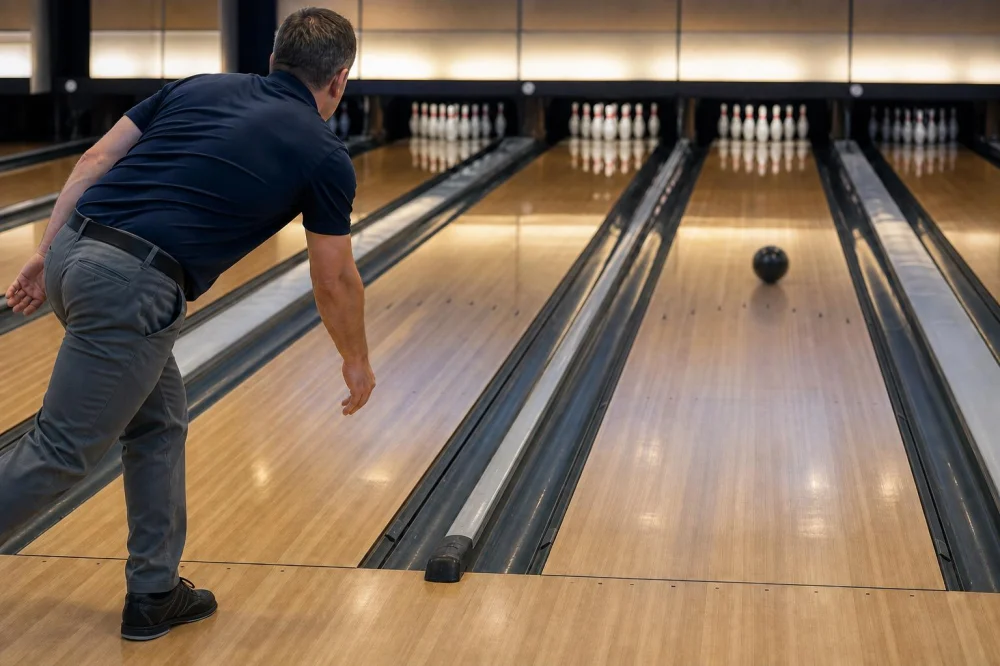
Why Your Bowling Ball Hooks Differently as Lanes Change
In this guide
A bowling lane is not a dry, unchanging surface. Conditioner—usually called lane oil—is applied in a controlled pattern, and every ball that travels down the lane moves a little of it. As the session continues, a shot that once reached the pocket can begin hooking earlier, sliding longer, or leaving a different pin. The useful response is observation and a small adjustment, not a complete rebuild of the swing.
Middletown Harmony Bowl
Middletown TownshipMonmouth CountyNew Jersey
1815 NJ-35, Middletown Township, NJ 07748, USA
Quick answer
Watch where the ball first changes direction and where it exits the pin deck, not only which pins remain. If the ball begins hooking too early and crosses high, move your feet and target slightly toward the oil while keeping the same release. If it skids too long and misses light, find a little more friction with a small move or a suitable ball. Change one variable at a time and give the new line more than one careful shot.
Nutmeg Bowl
FairfieldGreater Bridgeport Planning RegionConnecticut
802 Villa Ave, Fairfield, CT 06825, USA
Why bowling lanes use oil
Lane conditioner protects the lane surface and creates the playing environment. It is applied more heavily in some areas and lightly in others, producing a lengthwise and side-to-side pattern. The exact volume, distance, ratio, and shape vary among bowling centers, events, and lane machines.
Many recreational “house” conditions provide more oil toward the center and more friction toward the outside, helping a range of bowlers guide the ball toward the pocket. Competitive patterns may offer less built-in recovery and demand more precise speed, direction, and equipment choice.
The oil is difficult to judge reliably by eye. Read it through ball motion and information from the center rather than touching the lane, which is unsafe and contaminates shoes.
Skid, hook, and roll
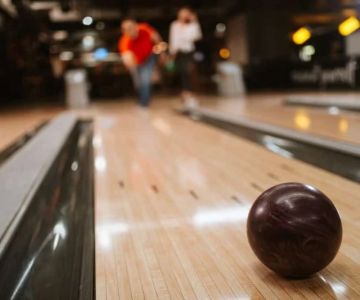
A typical performance ball first skids through the oiled front part of the lane, then gains friction and changes direction, and finally rolls toward the pins. These phases blend rather than switching at a single painted point.
More oil generally delays friction; a drier surface encourages the ball to slow and hook sooner. Ball surface, core, speed, revolutions, axis rotation, launch angle, lane topography, and environment all affect the shape.
A good shot is not simply the one with the most hook. It is one that uses energy predictably and enters the pins at a useful angle. Excessive early friction can make the ball roll out and hit weakly even after a dramatic curve.
How play changes the oil pattern
Bowling balls absorb, displace, and carry conditioner. Repeated shots on a similar line can reduce oil in the front or middle portion, creating more friction and earlier hook. Balls can also transport some oil farther downlane, sometimes creating carrydown that delays the final change of direction.
Transition is not identical on every lane. Right- and left-handed traffic, ball surfaces, number of players, warm-up shots, lane pair, machine application, and prior play influence it. Two lanes in the same pair may evolve differently.
A group using many plastic house balls may change the pattern differently from a league field using aggressive reactive-resin equipment. Avoid rigid rules such as “move every three frames.” Let the actual ball motion decide.
Read early hook and late skid
Early hook may show as the ball changing direction sooner, crossing high on the headpin, going through the nose, or losing energy before the pins. Late skid may show as the ball missing the expected breakpoint, entering light, or deflecting instead of continuing through the rack.
Pin leaves alone can mislead because the bowler may also have missed the target or changed speed. Watch the full path: arrows, middle-lane shape, breakpoint, pocket entry, and exit through the pins.
Ask whether the shot was executed normally before adjusting. A pulled shot, dropped speed, or changed hand position is not strong evidence that the lane changed.
Make one simple alignment move
For a right-handed bowler whose ball hooks too early and goes high, a common starting adjustment is moving the feet a small amount left and moving the visual target left by a smaller amount, sending the ball through a slightly oilier line. A left-handed bowler generally mirrors the direction. Exact boards depend on the bowler and pattern.
If the ball skids too far and hits light, a small move toward the drier outside portion may help. Another option is keeping the feet stable and changing only the target slightly. Avoid large jumps until a small move has been tested.
Use the approach boards and lane arrows as reference points. Remember the new starting board and target so the result can be compared, not guessed.
Use speed and release carefully
A little more ball speed can delay reaction; a little less can allow more time for friction. Reducing axis rotation can create a smoother shape, while greater rotation may create a sharper downlane move. These are advanced adjustments only when the bowler can reproduce them.
Changing hand position, speed, loft, target, and feet together destroys the comparison and can strain the body. Most recreational bowlers benefit from keeping the normal swing and making an alignment move first.
Do not force extra revolutions by twisting the wrist or elbow. A qualified coach can help develop a safe release. Pain is a reason to stop, not a lane condition to overcome.
Know what equipment can and cannot solve
Different coverstocks, surfaces, cores, layouts, and ball weights create different motion. A stronger or rougher reactive ball may read oil earlier, while a smoother or less aggressive ball can control friction. Plastic spare balls are designed for straighter motion.
Equipment is not a substitute for repeatability. Switching balls after every imperfect shot makes patterns harder to read. Use a ball long enough to understand the reaction, then change for a clear reason such as early roll, excessive jump, or persistent skid.
Follow manufacturer and pro-shop guidance for cleaning and surface maintenance. Do not apply an unapproved substance during competition, and check the rules that govern the session.
Adjust with a house ball
Conventional plastic house balls usually hook less than fitted reactive equipment, but they still respond to speed, direction, dry boards, and the bowler's release. Focus first on a comfortable legal grip, manageable weight, balanced finish position, and a repeatable target.
If a house ball begins crossing high, make a small move with the feet or target rather than trying to twist it harder. If it continually skids past the pocket, try a slightly slower controlled speed or a line with more outside friction, provided both feel safe.
Do not use a ball with finger holes that trap, pinch, or force the hand. Exchange it for a better fit and ask center staff for help.
Build a repeatable observation routine
- Choose the starting board and visual target.
- Make a normal, balanced delivery.
- Watch the ball at the arrows, breakpoint, pocket, and pin-deck exit.
- Decide whether execution was typical.
- If the pattern is clear across more than one shot, change one variable.
- Record the move and compare the next result.
During practice, alternate lanes as the scoring system directs. A move that works on the left lane may not be correct on the right. Keep notes simple enough to use without slowing other bowlers.
Frequently asked questions
Why did my ball stop hooking late in the game?
It may be seeing carrydown, a different line, more speed, or a changed release. Watch the entire path before deciding.
Do lanes always get drier as people bowl?
Oil is moved and depleted in complex ways. Some areas gain friction while other areas receive carried-down conditioner.
Should I wipe oil off my ball?
Use a clean approved towel and follow center or competition rules. Keep hands and towels away from the lane surface.
Why are the two lanes in my pair different?
Traffic, application, topography, ball choices, and prior play can differ. Treat each lane as its own observation.
Is more hook always better?
No. Predictable shape, pocket entry, energy retention, and repeatability matter more than total curve.
Watch the ball, then make a small change
Lane transition is part of bowling, not an equipment failure or personal mystery. Conditioner changes as balls travel, so the useful line evolves. Watch where the ball skids, turns, rolls, and exits the deck; separate execution errors from repeated motion; then adjust feet, target, speed, or equipment one step at a time. Small evidence-based moves keep the game understandable.


 Laurel Lanes4.0 (1895 reviews)
 Bowlero Milford4.0 (1430 reviews)
 The Patio at Revolutions4.0 (4 reviews)
 Agawam Bowl4.0 (235 reviews)
 Gil Hodges Lanes4.0 (73 reviews)
 Port Jeff Bowl4.0 (533 reviews)
 Best Bowling Alley Tips for Kids' Training: Improve Skills and Fun
 Why Ball Layout Changes Hook Shape Dramatically
 Why Tilt and Rotation Affect Hook Shape
 How to Choose the Right Bowling Lane for Best Performance
 How to Choose Between Two-Handed and One-Handed Bowling Styles
 Top Bowling Centers in Nashville for Music, Fun, and Bowling Experiences