
Bowling Wrist Support: Check Fit, Release, and Event Rules
On this page
Quick answer
A bowling wrist support limits some wrist movement to create a more repeatable hand position, but it can also change timing, ball fit, and release feel. Choose the correct hand and size, keep straps snug without numbness or pressure, test with a lighter practice session, and confirm competition rules. Stop for pain, tingling, swelling, or loss of grip.

Know what the support changes
A simple brace can reduce wrist collapse, while adjustable devices can set cup, extension, or lateral position. The goal may be consistency, technique feedback, fatigue management, or comfort. It does not automatically increase hook, speed, accuracy, or injury protection.
Changing wrist position changes how the fingers exit the ball and can alter launch direction and rotation. A support cannot fix every timing, footwork, or ball-fit issue. Ask a qualified coach or pro-shop technician to watch several shots before buying equipment based only on a product claim.

Circle Bowl & Entertainment
PiscatawayMiddlesex CountyNew Jersey
1665 Stelton Rd #1, Piscataway, NJ 08854, USA
Compare basic designs
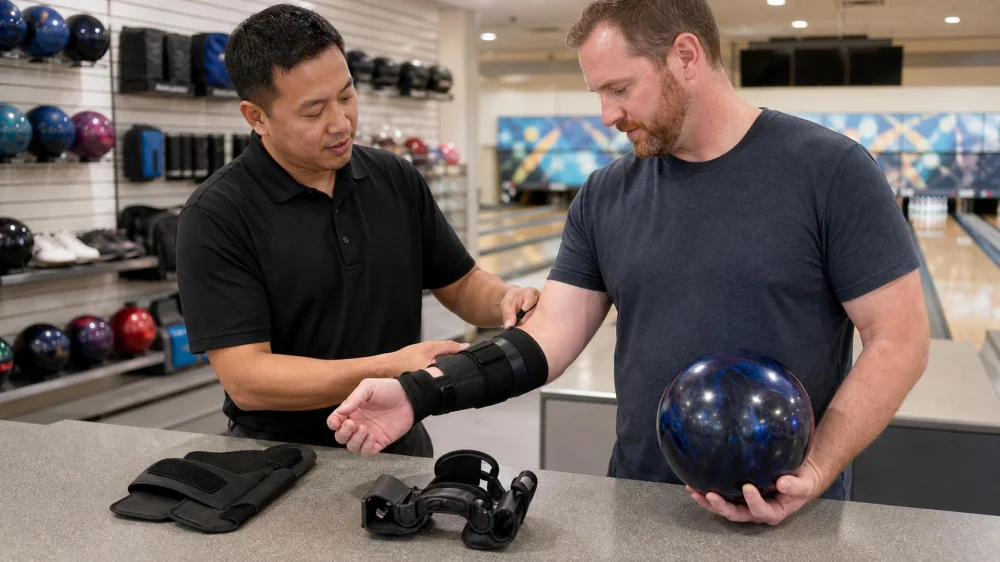
Fabric wraps provide light compression and broad movement. Rigid supports use metal or polymer stays to hold position. Adjustable models allow more settings but add weight and moving parts. Glove-style designs may include palm material that changes feel against the ball.
Choose right- or left-handed orientation correctly. Confirm whether the support is designed for bowling, whether replacement straps exist, and whether its edges interfere with finger holes. A bulky brace can make an otherwise comfortable ball feel different at setup.
Check fit and circulation
Measure according to the manufacturer’s chart and try the device over clean, dry skin. Position hinges, stays, and palm plates as instructed. Straps should hold the device without creating ridges, pinching the thumb base, or pressing into the forearm during the swing.
Open and close the hand, hold a ball safely at waist height, and check for tingling, colour change, cold fingers, swelling, rubbing, or restricted grip. Recheck after several minutes because pressure can build. Do not wear over a watch, bracelet, or thick seam that concentrates force.
Test the release gradually
Begin with dry swings or drills approved by a coach, then roll at reduced effort. Use a manageable ball and a short session. Keep the support setting unchanged for several shots while you observe start position, release, target, comfort, and ball reaction. Change one variable at a time.
Do not force the old release around a new brace. The ball may hang on the thumb or fingers if timing and fit no longer match. Stop when the ball sticks, falls early, or pulls the wrist. A pro shop should reassess fit rather than enlarging holes or modifying the support impulsively.
Confirm league or event rules
Open bowling usually follows house safety policy, while leagues and tournaments can restrict equipment, surfaces, mechanical aids, or changes during competition. Ask the league officer or tournament director before play and bring the exact device for inspection when required.
Do not assume a product sold in a pro shop is approved for every event. Adaptive bowling can have separate classifications and equipment rules. Record approval and settings. If a support breaks or must be replaced during competition, ask before substituting another model.
Clean, inspect, and replace
Air the support after use and clean it according to the manufacturer’s material instructions. Do not soak metal hinges or heat-dry foam unless permitted. Close hook-and-loop straps before storage so they do not snag towels or clothing. Store the device flat or in its shaped case.
Inspect stitching, straps, hinges, stays, padding, sharp edges, and adjustment locks. Retire a device that slips, cracks, exposes metal, or no longer holds its setting. Clean shared try-on supports between users through the pro shop’s process and wash hands after fitting.
Frequently asked questions
Will a wrist support make the ball hook more?
It can change release position and rotation, but ball fit, timing, speed, lane conditions, surface, and technique all matter. Results are not guaranteed.
How tight should the straps be?
Snug enough to prevent unwanted movement without numbness, tingling, cold fingers, swelling, or skin pressure. Recheck after a few frames.
Can I wear one for wrist pain?
Do not use equipment to mask pain. Stop bowling and seek advice from a qualified health professional. A bowling support is not a diagnosis or treatment plan.
Evidence and limitations
This guide reflects common bowling coaching, pro-shop fitting, and equipment care practice: define the purpose, fit without circulation pressure, test gradually, reassess ball fit, confirm rules, and stop for symptoms. Device instructions, individual anatomy, event rules, and health conditions vary. Coaches, technicians, officials, and clinicians have different roles.
Conclusion and next steps
Choose the intended support level, verify handedness and size, and fit it with normal circulation. Test through a short controlled session while changing one setting at a time. Confirm league approval, clean the device, and stop rather than bowling through pain or a release that no longer clears the ball safely.



 Blue Valley Lanes Inc4.0 (387 reviews)
 Spins Bowl Carmel4.0 (443 reviews)
 Jib Lanes4.0 (1340 reviews)
 New City Bowl & Batting Cages4.0 (640 reviews)
 Round1 Bowling & Arcade Galleria at Crystal Run4.0 (1955 reviews)
 Bowlerland3.0 (1298 reviews)
 Bowling Tips for League Beginners to Improve Your Game Fast
 Why Bowling Requires Both Strength and Finesse
 Best Family-Friendly Bowling Alleys with Kids Activities and Party Packages
 What Is a Turkey in Bowling and Other Fun Bowling Terms Explained
 Why Some Bowlers Prefer Two-Finger Grips
 Bowling Lane Oil: Read the Pattern as Conditions Change